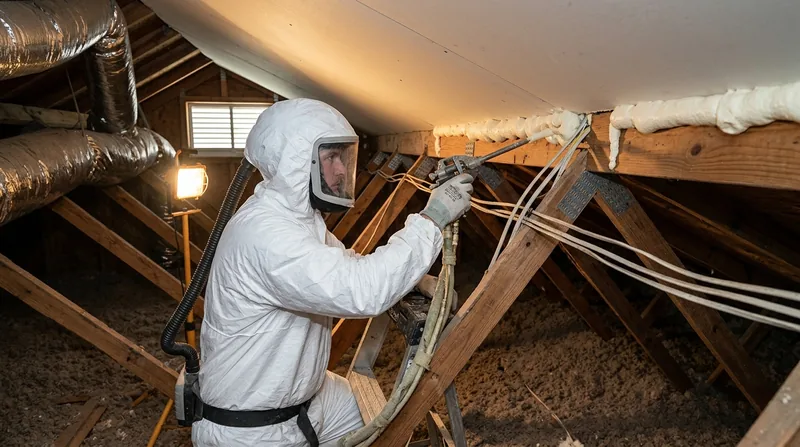




Port St. Lucie's housing stock is dominated by single-story concrete block homes built on slab-on-grade foundations from the 1980s through the 2000s, nearly all of them running ductwork and air handlers through vented attics. In IECC climate zone 2A, hot and humid air finds every gap in your ceiling plane during the long cooling season. Humidity never leaves the Treasure Coast, and vapor drive runs from the hot, wet outside air straight toward your air-conditioned interior, pulling moist air into attics and rooms below whenever there is a gap at the top plate or around penetrations. Air sealing in Port St. Lucie stops that leakage before it starts. We seal top plates, penetrations and attic air leaks so conditioned air stays where it belongs, your rooms cool evenly, and your system does not waste energy fighting humid air that should never have entered the attic in the first place. Learn more about how attic spray foam insulation complements air sealing in a complete thermal envelope strategy.
Why Air Sealing Matters in Port St. Lucie's Hot, Humid Climate
The long cooling season in Port St. Lucie puts relentless pressure on every gap in your ceiling plane. Ductwork baking in an unconditioned attic loses 20 to 30 percent of its cooled air to the surrounding heat before that air ever reaches the rooms you are trying to cool. Worse, humid outside air leaks into the attic through unsealed top plates and penetrations, pulling moisture down into the living spaces below and forcing your air conditioner to work harder to dehumidify air that should have stayed outside in the first place. Rooms far from the air handler never cool evenly because ductwork loses pressure and temperature as it travels through the hot attic. Air sealing closes those gaps and stops the moisture at the source.
- Seal top plates and rim areas where humid air enters the attic from living spaces below.
- Close penetrations around electrical wiring, plumbing stacks and HVAC return ducts that create direct paths for moisture.
- Stop conditioned air from leaking into the attic, where it cools nothing and wastes energy.
- Reduce the moisture load your air conditioner must handle, lowering runtime and power consumption.
- Enable more even room temperatures throughout the house by stabilizing ductwork pressure.
Air sealing is the first step before adding insulation, and it is the single biggest credibility differentiator between a spray foam shop that understands the trade and one that does not.
Key info: Port St. Lucie building codes and energy standards are enforced by the local building department, not by us. Attic ventilation, ignition barriers and thermal barriers are governed by the energy code in force at your address. We help you navigate what applies and defer to the building official on every job.
For detailed guidance on local regulations, visit the City of Port St. Lucie Building and Development Services or contact your local building department to confirm requirements for your address.
How We Perform Air Sealing in Port St. Lucie Homes
Air sealing starts with a careful walk-through of your attic to identify every gap, crack and penetration where air and moisture can leak. We inspect the top plate where the wall framing meets the attic, trace electrical and plumbing penetrations, check around ductwork and return air plenums, and look for gaps where additions or roof features have created discontinuities in the thermal envelope. Once we have mapped the leakage, we seal those gaps using spray foam, caulk or mechanical blocking, depending on the size and location of each opening. The goal is to create a continuous air barrier at the ceiling plane so that conditioned air stays in the living space and humid outside air stays out of the attic.
- Inspect the attic thoroughly to locate gaps, cracks and penetrations at the top plate and around mechanical and electrical systems.
- Identify moisture entry points and air leakage paths that pull humid air into the attic or conditioned air out of the living space.
- Seal top plates and band joists with spray foam to create a continuous thermal and air barrier.
- Close penetrations around wiring, plumbing and ductwork with foam or caulk, sized to the opening.
- Verify the seal with a visual inspection and confirm that the attic is ready for insulation or re-insulation.
The result is a tight, controlled attic that holds conditioned air where it belongs and keeps humidity from entering the living spaces below.
Local example: A 1990s block home in Tradition or St. Lucie West with a vented attic typically has 8 to 12 major air leaks at the top plate, plus 15 to 25 smaller penetrations around electrical and plumbing. Sealing those gaps costs $650 to $1,200 and cuts the attic moisture load by 40 to 60 percent, so your air conditioner runs shorter cycles and your rooms cool more evenly.
See how air sealing integrates with rim joist and band joist foam insulation to create a complete thermal boundary.
Air Sealing Methods and Approaches
| Approach | Description | Best For |
|---|---|---|
| Spray Foam Sealing | Closed cell or open cell foam applied to gaps at top plates, penetrations and rim joists. Expands to fill irregular shapes and creates an air-tight, moisture-resistant seal. | Large gaps, complex penetrations, areas where moisture control is critical, and any seal that will remain exposed. |
| Caulk and Sealant | High-quality polyurethane or acrylic caulk applied to small cracks, seams and linear gaps. Does not expand, so it is sized precisely to the opening. | Small gaps less than one-quarter inch, seams between framing members, and areas where foam would be overkill. |
| Blocking and Framing | Rigid board or lumber cut and fit to fill large gaps, then sealed with foam or caulk. Creates a solid backing for the seal and is often required by code around large penetrations. | Large openings, areas where structural support is needed, and attic access hatches or pull-down stairs. |
| Combination Approach | Foam for major top plate sealing and large penetrations, caulk for small cracks, and blocking for attic access or large gaps. Tailored to the specific leakage pattern of your attic. | Most Port St. Lucie homes, where attics have a mix of small and large gaps and require a targeted, efficient seal. |
Air Sealing Cost in Port St. Lucie: What to Expect
Air sealing costs in Port St. Lucie typically start at $650 to $800 for a straightforward top plate and penetration seal on a single-story block home with a standard attic layout. The final price depends on the size of the attic, the number and size of gaps, whether you are sealing only the top plate or also addressing rim joists and large penetrations, and the difficulty of access. A home with extensive ductwork, multiple HVAC returns and complex framing will cost more than a simple, open attic. Getting written estimates from 2 to 3 contractors is the smart move, because every attic is different and the scope of sealing work can vary significantly from house to house. See our full pricing overview for more detail on what moves the cost up or down, and call us at (772) 877-0850 for a free, no-obligation estimate with R-value and thickness specs spelled out on paper.
Never accept an estimate without a written scope that names the areas to be sealed, the method (foam, caulk or blocking), and the expected result. A vague estimate with no specifics is a sign that the contractor has not looked at your attic carefully enough to give you an honest price.
What to Look for When Hiring a Spray Foam Air Sealing Contractor Near Port St. Lucie
Hiring the right air sealing contractor starts with verifying that the contractor is fully insured and can show you a current certificate of insurance on request. Ask for references from recent jobs in Port St. Lucie, Fort Pierce, Stuart or Jensen Beach, and call at least two of them to ask about the quality of the seal, whether the contractor showed up on time and cleaned up afterward, and whether any odor or off-gassing issues occurred after the job. Get written estimates from at least two contractors, and compare the scope, materials and price side by side. Do not award the job to the lowest bidder if the estimate is vague or missing details. The best estimate will name the specific areas to be sealed, the method and material for each area, and the expected R-value or performance outcome. Ask the contractor whether the job requires a permit in your city or HOA, and whether the contractor will help you navigate the permitting process. Port St. Lucie and surrounding cities have different registration and permitting rules, so always confirm with your local building department what applies to your address before you sign a contract.
- Verify that the contractor is fully insured and can provide a current certificate of insurance.
- Request references from recent air sealing jobs in your city or nearby, and call them to ask about quality and professionalism.
- Obtain written estimates from at least two contractors, with scope, materials and expected performance spelled out clearly.
- Confirm with your local building department whether a permit is required for air sealing work at your address.
- Ask whether the contractor has experience with your specific attic layout and whether they can identify all major air leaks before giving a price.
- Check that the contractor has a local address and local contact information, not just a toll-free number or out-of-state headquarters.
The best contractor is the one who takes time to inspect your attic, gives you a detailed written estimate, answers your questions honestly and is reachable after the job is done. Contact us for a free estimate and we will show you exactly what we plan to seal and why.
Air Sealing in Port St. Lucie: Pricing Guide
| Service | Price | Details |
|---|---|---|
| Standard Top Plate and Penetration Sealing | Starting at $650 | Includes top plate foam seal and closure of 15 to 25 electrical and plumbing penetrations in a typical 1980s-2000s block home attic |
| Extended Air Sealing with Rim and Band Joist | Starting at $950 | Adds rim joist and band joist foam sealing to top plate and penetration work, creating a complete thermal boundary at the ceiling plane |
| Complex Attic with Large Gaps or Multiple Ductwork Returns | On estimate | Extensive sealing, blocking or foam application around complex HVAC layouts requires on-site inspection to determine scope and accurate pricing |
| Air Sealing Plus Insulation Preparation | Starting at $1,100 | Combines air sealing with removal of old insulation or preparation of the attic for new blown-in or spray foam insulation coverage |
| Travel and Site Visit | Included | No separate travel charge or mileage fee for jobs in Port St. Lucie, Fort Pierce, Stuart, Jensen Beach and surrounding service areas |
| Free Written Estimate | Free | On-site inspection with written scope, materials and pricing, no obligation to book. Response within 24 hours at (772) 877-0850 |
Indicative pricing, the exact cost depends on square footage, finish, and site access. Free personalized estimate within 24h at (772) 877-0850.


