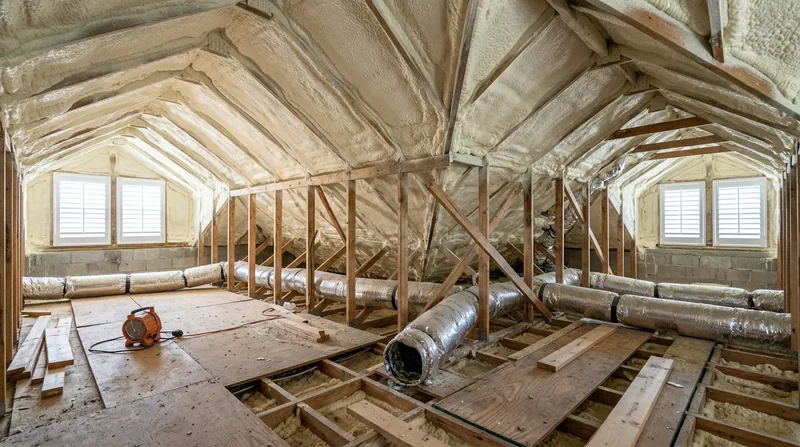




Attic spray foam insulation in Port St. Lucie is the single most effective way to stop ductwork heat loss and keep rooms cool when the summer sun bakes your roof deck. Port St. Lucie's housing stock, dominated by single-story concrete block homes built from the 1980s onward, sits on slab foundations with vented attics that reach 140+ degrees in July and August. Your air conditioning ducts run through that superheated space, losing cooling energy all day long, which is why rooms far from the air handler never reach temperature no matter how hard the system runs. We seal the ceiling plane, foam the roof deck, and bring your home's envelope into the modern building science. The result is cooler rooms, a quieter air handler, and real money back on your power bill every month of the cooling season.
Why Attic Spray Foam Insulation Matters in Port St. Lucie's Hot Climate
Port St. Lucie sits in IECC climate zone 2A, which means hot, humid air and a cooling season that runs nine months a year. Your vented attic is not insulated from the outside; it breathes with the weather and acts as a heat engine. Ductwork sitting in that attic loses 25 to 40 percent of its cooling energy before it ever reaches your living space. Humidity never leaves the Treasure Coast, and vapor drive runs from the hot, wet outside air toward your air-conditioned interior, pulling moist air straight into the attic and down through every gap at the ceiling plane. Sealing and insulating the roof deck stops that leak and brings your ducts into conditioned space.
- Reduces ductwork heat loss by 25 to 40 percent, so rooms cool faster and more evenly.
- Stops humid outside air from entering the attic and the rooms below through ceiling gaps.
- Lowers air handler runtime and compressor cycling, extending equipment life.
- Qualifies for federal energy efficiency tax credits when installed as part of a complete air sealing project.
A properly sealed and insulated attic is not a luxury in Port St. Lucie; it is the foundation of efficient cooling and the only way to stop the moisture cycle that drives mold risk and insulation failure.
Key info: Port St. Lucie and nearby Stuart, Jensen Beach, and Palm City all share the same climate zone and building stock. Single-story block homes from the 1980s through 2000s dominate these neighborhoods. Vented attics with ductwork running through them are the standard, and duct loss is the biggest cooling efficiency problem these homes face.
For more on the science of air sealing and moisture control, see our air sealing service page.
How We Seal and Insulate Your Attic: The Port St. Lucie Process
Every attic job starts with a walk-through to understand your ductwork layout, existing insulation condition, and moisture history. We identify all air leaks at the ceiling plane, rim joists, and ductwork penetrations. We then decide whether to seal and foam the roof deck (a sealed attic approach) or foam around ducts and air seal the ceiling plane while leaving the attic vented. The choice depends on your attic's current condition, your budget, and your long-term comfort goals. Once we have a plan, we remove any failed or contaminated insulation, seal all gaps with foam and caulk, spray the roof deck or the ceiling plane with closed cell or open cell foam to the R-value your climate requires, and install thermal and ignition barriers as your local building code mandates.
- We walk your attic and map ductwork, air leaks, and insulation condition before any estimate.
- We remove any existing insulation that is wet, compressed, or contaminated with debris.
- We air seal all penetrations, gaps at the ceiling plane, and ductwork connections with foam and caulk.
- We spray closed cell or open cell foam to the thickness and R-value specified in your written estimate.
- We install thermal and ignition barriers to meet your local building code and the local building official's requirements.
- We provide mechanical ventilation during cure and a stated re-entry window of 24 to 48 hours before you return to the attic.
The entire process is transparent, with no surprises and no hidden costs on the day of the job.
Example: A 1,800 square foot single-story home in Port St. Lucie with a vented attic and ductwork running through it typically needs 2,000 to 2,200 board feet of closed cell foam at 1.5 inches to seal the roof deck and achieve an R-value of R-20 to R-24. If the attic is larger or the ductwork more complex, the footage goes up. We size every job on site and deliver a written estimate with R-value and thickness specs before we spray a single pass.
Learn more about the difference between closed cell and open cell spray foam on our service pages.
| Approach | Description | Best for |
|---|---|---|
| Sealed Roof Deck (Closed Cell) | Foam sprayed on the underside of the roof deck to R-20 or R-24. Attic becomes conditioned space. Ducts and air handler are now inside the thermal envelope. | Homes where ductwork is old, leaky, or inaccessible for sealing. Maximum cooling efficiency and moisture control. |
| Air Sealed Ceiling Plane (Closed Cell) | Foam applied at the ceiling plane and around ductwork penetrations. Attic remains vented. Stops air and moisture from entering living space. | Homes with newer ductwork in good condition. Lower cost than sealed deck. Still stops the humidity leak. |
| Open Cell Attic Foam | Lower-density foam sprayed to R-19 or R-21 for sound dampening and air sealing. Breathable, allows vapor to dry to the attic. | Budget-conscious homeowners. Attics with good ventilation and no moisture history. Noise reduction benefit. |
| Blown-In Insulation Top-Up | When existing insulation is sound but thin, we add blown fiberglass or cellulose to reach current code R-value without removing or spraying. | Attics with no air leaks, no moisture, and existing insulation in good condition. Lowest cost option. |
Attic Spray Foam Insulation Cost in Port St. Lucie: What to Expect
Attic spray foam insulation cost in Port St. Lucie typically starts at $1.50 per square foot for a basic air seal and foam application at the ceiling plane, and rises to $2.50 to $3.50 per square foot for a full sealed roof deck with closed cell foam and all thermal barriers installed. A typical 2,000 board foot attic job runs between $3,000 and $7,000 depending on the approach, the existing insulation condition, and whether removal and disposal are required. The single biggest variable is whether your existing insulation is sound or needs to come out. Wet, compressed, or contaminated insulation adds removal cost and labor time. Access to the attic, the complexity of your ductwork layout, and the thickness of foam required by your local building code also move the price. We always deliver a written estimate with R-value and thickness specified, so you know exactly what you are paying for before we start.
Never accept an estimate without a board footage number, a thickness in inches, an R-value, and a breakdown of labor and materials. That is how you spot a contractor who does not measure on site or does not stand behind the work. Get 2 to 3 estimates from local contractors and compare the specs, not just the price. The cheapest bid is often the one that will cost you the most in callbacks and moisture problems later.
Visit our full pricing page for more detail on what moves the cost up and down, and call us at (772) 877-0850 for a free, no-obligation estimate with written specs.
What to Look for When Hiring an Attic Spray Foam Insulation Contractor Near Me in Port St. Lucie
Spray foam insulation is a specialized trade, and the difference between a good installation and a bad one is not visible until the problems start. A poorly installed foam job can smell for months, fail to seal air leaks, or leave gaps that undo all the R-value you paid for. Here is what to verify before you hire any contractor, including us. First, ask for proof of full insurance coverage and request a certificate of insurance with your project name listed. Never hire a contractor who cannot or will not provide this. Second, get a written estimate that includes the R-value, the thickness in inches, the board footage, the type of foam (closed cell or open cell), and the cost of removal and disposal if needed. If the estimate is vague or lists only a price per square foot with no specs, walk away. Third, ask about the contractor's process during cure: do they provide mechanical ventilation, and what is the re-entry window they guarantee. Reputable installers always ventilate during cure and recommend 24 to 48 hours before re-entry. Fourth, check references from jobs completed in Port St. Lucie, Stuart, Jensen Beach, or Palm City within the last two years. Ask those homeowners about the smell, the timeline, and whether the contractor was reachable after the job. Fifth, verify that the contractor is familiar with your local building department's requirements for attic ventilation, ignition barriers, and thermal barriers. Permitting rules vary between Port St. Lucie, Fort Pierce, and the surrounding cities, and a local contractor knows the code official's expectations. Sixth, ask whether the contractor pulls permits or helps you navigate what applies at your address. The honest answer is that permitting and registration vary by city, and the contractor's job is to help you understand what your building department requires, not to promise they will handle everything. Finally, ask about the contractor's warranty on workmanship. A one to three year warranty on the installation is standard and honest; anything longer is a red flag.
- Verify full insurance coverage with a certificate naming your project before you sign a contract.
- Demand a written estimate with R-value, thickness, board footage, foam type, and removal cost itemized separately.
- Ask about mechanical ventilation during cure and the guaranteed re-entry window, which should be 24 to 48 hours.
- Call references from recent jobs in Port St. Lucie or nearby Martin County and ask about smell, timeline, and post-job communication.
- Confirm the contractor is familiar with your city's building code for attic ventilation, ignition barriers, and thermal barriers.
- Ask whether the contractor helps you understand local permitting requirements or claims to pull all permits themselves.
- Expect a one to three year workmanship warranty; anything longer is not credible.
The local independent contractor with a local address and local plates is your best bet. Avoid rig-and-run crews that arrive in an out-of-state trailer, spray the job in an afternoon, and disappear when the smell does not go away. Avoid national franchises that quote by phone and send a crew with no local accountability. Call us at (772) 877-0850 or visit our contact page to schedule a free estimate and ask any questions about our process, insurance, or warranty.
Attic Spray Foam Insulation in Port St. Lucie: Pricing Guide
| Service | Price | Details |
|---|---|---|
| Air Sealed Ceiling Plane (Closed Cell) | Starting at $1.50/sq ft | Foam applied at ceiling plane and around ductwork penetrations. Cost varies with attic size, existing insulation condition, and whether removal is required |
| Sealed Roof Deck (Closed Cell) | Starting at $2.50/sq ft | Full roof deck sealed to R-20 or R-24. Attic becomes conditioned space. Price depends on square footage, foam thickness, and thermal barrier installation |
| Open Cell Attic Foam | Starting at $1.25/sq ft | Lower-density foam for sound dampening and air sealing. Breathable option for well-ventilated attics with no moisture history or prior damage |
| Insulation Removal and Disposal | On estimate | Required if existing insulation is wet, compressed, or contaminated. Adds labor and disposal cost; always quoted separately with board footage |
| Estimate | Free | Written estimate with R-value, thickness, board footage, and itemized costs. Response within 24 hours at (772) 877-0850, no obligation to book |
Indicative pricing, the exact cost depends on square footage, finish, and site access. Free personalized estimate within 24h at (772) 877-0850.


