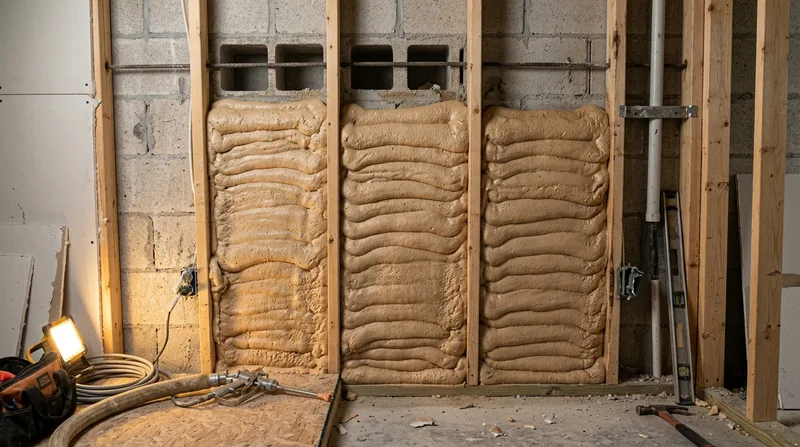




Closed cell spray foam insulation in Port St. Lucie stops moisture and heat at the source in a climate where humidity never really leaves. Port St. Lucie's housing stock is dominated by single-story concrete block homes built on slab-on-grade foundations from the 1980s through the 2000s, nearly all of them with ductwork and air handlers running through vented attics. In this hot, humid environment where the cooling season stretches year-round, vapor drive pushes moist outside air inward through every gap at the ceiling plane and top plate. Closed cell foam adds rigidity, acts as a vapor retarder, and seals the leaks that fiberglass and blown-in insulation cannot. We spray it in rim joists, block walls, and crawl spaces to stop that moisture and hold the cold air where it belongs. This is not just comfort; it is the difference between a room that cools and one that does not.
Why Closed Cell Spray Foam Matters in Port St. Lucie's Hot, Humid Climate
Port St. Lucie sits in IECC climate zone 2A, where air conditioning runs almost year-round and ductwork baking in attic heat is the norm. Fiberglass batts and blown-in cellulose do not seal the gaps that let humid air into attics and into the living spaces below. Rooms far from the air handler never cool properly no matter how hard the system runs, and the real culprit is not the thermostat, it is the leaks at the ceiling plane and the moisture that rides in with them. Closed cell foam seals those leaks and adds R-value per inch that open cell and fiberglass cannot match. It also acts as a vapor retarder, which in this climate is not optional.
- We seal rim joists and band joists where block walls meet the foundation, stopping the path moisture takes into crawl spaces and into walls.
- We spray closed cell foam into concrete block walls in retrofit work without demolition, adding R-value and a vapor barrier in one pass.
- We seal crawl spaces and attics where vapor drive is strongest, using closed cell to hold the humidity out and the conditioned air in.
- We remove failed insulation and spray foam correctly the first time, with mechanical ventilation during cure and a clear re-entry window of 24 to 48 hours.
The result is a home that cools faster, holds temperature longer, and does not smell like chemicals weeks after the work is done.
Key info: Port St. Lucie and Martin County homes built from the 1980s onward sit on slabs with vented attics. There are no basements here and few true crawl spaces. Every one of these homes has its failure mode: the attic gap, the rim joist leak, the block wall that sweats. Closed cell foam is the only retrofit that seals all three without tearing the house apart.
For more on how moisture and heat escape through your attic, see our guide to attic spray foam insulation in Port St. Lucie.
How We Install Closed Cell Spray Foam Insulation in Port St. Lucie
Closed cell spray foam is sprayed in place, one inch at a time, and cures to a rigid foam that does not sag, does not settle, and does not let air move through it. We measure the job on site in board feet, spray to the specified thickness with the manufacturer ratio and drum temperature correct, and run mechanical ventilation during cure. The foam hardens in 24 to 48 hours. We do not promise immediate re-entry, and we do not spray over wet, contaminated, or leaking substrates. If the moisture comes first, we fix that first or we walk away.
- We inspect the site, measure the area to be sprayed, and identify any moisture or contamination that must be addressed before foam goes down.
- We set up mechanical ventilation and establish a re-entry window based on the foam system and cure conditions.
- We spray closed cell foam in controlled passes, one inch per pass, building to the specified R-value and thickness.
- We allow the full cure time, typically 24 to 48 hours, before the space is re-occupied.
- We inspect the finished work for coverage, thickness, and any thermal barrier or ignition barrier requirements under local code.
The entire process is documented so you know exactly what was sprayed, where, and to what thickness and R-value.
Example: A rim joist in a Port St. Lucie block home built in 1995 sits on the foundation with no insulation and no seal. We spray 2 inches of closed cell foam into that cavity, which adds R-12 to R-13, seals the rim to the block, and acts as a vapor retarder. The room above stays cooler, the floor does not sweat in summer, and mold does not grow in the rim cavity.
If you are considering crawl space spray foam insulation, the same principles apply: we seal the rim, spray the walls, and control the moisture before it enters your home.
Closed Cell Spray Foam Methods and Applications
| Application | Description | Why It Works in Port St. Lucie |
|---|---|---|
| Rim and Band Joist Sealing | Spray 1 to 2 inches of closed cell foam into the rim cavity where the block wall meets the foundation, sealing air and moisture leaks. | Stops the primary path for humid air to enter crawl spaces and living spaces. Acts as a vapor retarder and adds R-value where heat loss and moisture gain are highest. |
| Block Wall Retrofit (Injection Foam) | Inject closed cell foam into the core of concrete block walls from the interior, filling voids and sealing the wall without demolition. | Adds R-value and a vapor barrier to 1980s and 1990s block homes. Stops condensation on interior block surfaces in summer, a common failure in this climate. |
| Crawl Space Walls and Rim | Spray closed cell foam on crawl space walls and rim joists, creating a continuous vapor retarder and thermal barrier. | Port St. Lucie has few true crawl spaces, but where they exist, closed cell stops moisture from entering through the rim and walls. The foam is rigid and does not absorb water. |
| Sealed Attic Decks (Rafter Bays) | Spray closed cell foam between rafters on the underside of the roof deck, sealing the attic and creating a conditioned space. | Stops vapor drive at the roof, seals ductwork leaks, and allows the HVAC system to work efficiently. In hurricane season, a sealed attic is also more resilient to wind pressure. |
| Garage and Metal Building Walls | Spray closed cell foam on interior walls of garages and metal buildings, adding insulation and a vapor retarder in one pass. | Metal buildings and garage walls sweat in Port St. Lucie's humidity. Closed cell stops condensation on the inside surface and adds thermal resistance without taking up floor space. |
Closed Cell Spray Foam Insulation Cost in Port St. Lucie: What to Expect
Closed cell spray foam costs more per board foot than open cell or fiberglass, but it delivers higher R-value per inch, acts as a vapor retarder, and does not settle or lose R-value over time. In Port St. Lucie and the surrounding areas, closed cell foam typically starts at $1.20 per board foot for straightforward jobs like rim joists and band joists. Larger jobs, such as sealed attic decks or block wall retrofit, may cost more per board foot depending on access, the complexity of the substrate, and whether old insulation must be removed first. Travel is included in Port St. Lucie and surrounding areas, and there is no separate mileage fee.
Several factors move the price up or down. A rim joist that is easy to access costs less than one buried behind ductwork. A crawl space with standing water or contamination must be addressed before foam goes down, which adds cost and time. A block wall retrofit with injection foam is priced by the linear foot and the depth of the cavity. An attic sealed with closed cell on the roof deck is priced by the board foot and the R-value target, which depends on local code.
The best way to know what a job will cost is to get a written estimate with the R-value, thickness, and board footage spelled out. We provide estimates for free within 24 hours. Call (772) 877-0850 or visit our contact page to request one. For a full overview of pricing and what is included at each level, see our pricing page.
Closed Cell Spray Foam Insulation Near Me: What Port St. Lucie Homeowners Should Know When Hiring
Hiring a spray foam contractor is not the same as hiring a tree service or a plumber. The trade has its rig-and-run crews, an out-of-state trailer that sprays a job in an afternoon and disappears when the smell will not go away. It also has national franchises with high overhead and no local accountability. The local independent shop is positioned against both. When you are evaluating any contractor, including us, look for these markers of honest work.
- Ask for a written estimate that names the R-value, thickness, and board footage, not just a price per board foot or a vague total.
- Verify that the contractor is fully insured and ask to see the certificate of insurance, which covers liability and workers compensation.
- Ask whether the contractor will run mechanical ventilation during cure and what the re-entry window will be, typically 24 to 48 hours.
- Check with your local building department to confirm what permits and inspections apply at your address, and whether thermal barrier or ignition barrier requirements are part of the job.
- If your home is in a master-planned community like Tradition or St. Lucie West, check HOA rules for any architectural approval required on exterior work or metal buildings.
- Ask the contractor to explain what happens if the substrate is wet or contaminated, and listen for the answer: we fix the moisture first or we walk away.
The strongest signal of a professional is one who says no to a bad job and walks away from a job that will fail. A contractor who promises immediate re-entry, who does not run ventilation, or who gives you a price without seeing the site is not the one to call.
For more help navigating the process, contact us for a free estimate. We are here to answer questions and help you understand what applies to your home.
Closed Cell Spray Foam Insulation in Port St. Lucie: Pricing Guide
| Service | Price | Details |
|---|---|---|
| Rim Joist and Band Joist Sealing | Starting at $1.20/board ft | 1 to 2 inches of closed cell foam sealing the rim cavity. Price moves with linear footage and access difficulty to the rim. |
| Block Wall Injection Foam Retrofit | Starting at $1.50/board ft | Injection foam into concrete block cores without demolition. Price varies by wall area, cavity depth, and whether old insulation must be removed first. |
| Crawl Space and Sealed Attic Decks | Starting at $1.20/board ft | Larger square footage jobs sprayed to specified R-value and thickness. Price per board foot may decrease on larger volumes; access and substrate condition affect final cost. |
| Garage and Metal Building Walls | Starting at $1.30/board ft | Interior wall spray for condensation control and thermal resistance. Price depends on wall area, height, and whether existing insulation must be removed. |
| Insulation Removal and Replacement | On estimate | Removal of failed foam or fiberglass, substrate repair, and new closed cell installation. Scope and contamination status require on-site assessment before pricing. |
| Free Estimate | No obligation | Written estimate with R-value, thickness, and board footage within 24 hours. Call (772) 877-0850 or request online; travel included in Port St. Lucie and surrounding areas. |
Indicative pricing, the exact cost depends on square footage, finish, and site access. Free personalized estimate within 24h at (772) 877-0850.


