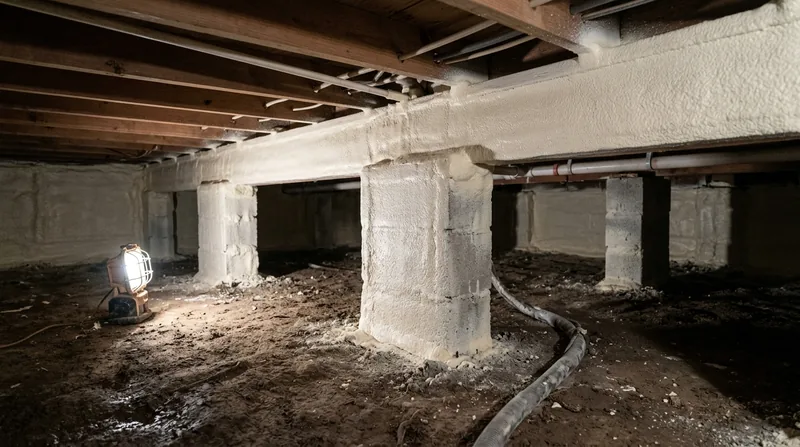




Crawl Space Spray Foam Insulation in Port St. Lucie is a specialized solution for the rare but critical homes that sit on true crawl spaces rather than the slab-on-grade foundations that dominate the Treasure Coast. While most of Port St. Lucie's single-story concrete block homes built from the 1980s onward rest on slabs, older neighborhoods toward Stuart, Palm City, and Jensen Beach in Martin County still have homes with crawl spaces underneath. These spaces are direct conduits for humid outside air to infiltrate your home, driving moisture straight into the walls and rooms above, which makes the air conditioning work harder and creates the perfect environment for mold and wood rot. Sealing and insulating a crawl space with spray foam stops that humid air at the source, protecting your structure and lowering your cooling costs year-round. We remove the old vents, seal the foundation walls with closed cell or open cell foam, and create a controlled, dry barrier between the hot, wet ground and your living space. Our process is straightforward, our estimates are written with R-value and thickness specs, and we walk away if the substrate is wet or contaminated. Call us at (772) 877-0850 for a free, no-obligation estimate, or visit our contact page to request one online.
Why Crawl Space Insulation Matters in Port St. Lucie's Hot, Humid Climate
Port St. Lucie sits in IECC climate zone 2A, a hot and humid region where vapor drive runs relentlessly from the outside air toward your air-conditioned interior. Any gap or unsealed surface in a crawl space pulls that moist air directly into the rim joists, band joists, and framing above, where it condenses and begins to damage wood. The air handler and ductwork that run through most attics in this area already work overtime fighting the heat load from outside, and when humid air leaks in from below, that burden compounds. A properly sealed and insulated crawl space stops humid air at the foundation wall, keeping it out of the structure entirely, which means your HVAC system runs shorter cycles and your rooms stay comfortable without the moisture risk.
- Stops humid outside air from entering the rim joist and band joist cavities, which are the primary leak path in homes with crawl spaces.
- Prevents wood rot and mold growth in the framing directly above the crawl space, where moisture damage spreads quickly in Florida's climate.
- Reduces the load on your air conditioning system by creating a dry, conditioned foundation instead of an open, humid void.
- Protects plumbing and electrical runs that often pass through crawl spaces, extending their service life in a corrosive, moist environment.
- Creates an accessible, usable space for future repairs or inspections without the risk of stepping into standing water or contaminated soil.
These benefits compound over time, making crawl space insulation one of the most cost-effective upgrades for the few Port St. Lucie homes that have them.
Key info: Crawl spaces in older Martin County homes near Stuart and Palm City often have vented foundations that allow unconditioned, humid air to circulate freely. Sealing those vents and foaming the walls is the only way to stop the moisture intrusion that drives up cooling costs and shortens the life of structural framing in this climate.
For more on how spray foam controls moisture in other critical zones, see our guide to rim joist and band joist spray foam insulation, which often works hand in hand with crawl space sealing.
How We Seal and Insulate Crawl Spaces in Port St. Lucie: The Process
Our crawl space spray foam process begins with a walk-through inspection to assess the foundation condition, moisture levels, and current venting. If the space is dry and the substrate is sound, we plan the foam application. We remove or close the foundation vents to stop humid air intake, then apply spray foam to the interior foundation walls from the rim joist down to the sill plate. We use either closed cell foam for maximum moisture control and structural strength, or open cell foam if the budget is tighter and moisture risk is lower. The foam is applied in controlled passes to the specified thickness, creating a continuous air and vapor barrier that keeps humid air out and conditioned air in. Once the foam cures, typically within 24 to 48 hours, the crawl space becomes a dry, usable foundation zone.
- We inspect the crawl space for standing water, active leaks, or contamination and walk away if the substrate is not dry and stable.
- We seal or remove existing foundation vents to stop the intake of humid outside air into the space.
- We apply spray foam to the interior foundation walls, covering the rim joist, band joist, and sill plate in continuous coverage.
- We specify the foam type (closed cell or open cell) and thickness based on your crawl space moisture profile and local code requirements.
- We establish a re-entry window of 24 to 48 hours and provide written guidance on how long mechanical ventilation should run during cure.
- We deliver a written estimate with R-value and thickness specifications before any work begins.
This methodical approach ensures the foam bonds properly and the moisture barrier is complete from the moment the job is finished.
Example: A 1990s concrete block home in Palm City with an open crawl space and vented foundation was losing cool air and pulling humid air into the band joist above. We sealed the vents, foamed the walls with closed cell foam to R-20, and the homeowner reported lower cooling costs and no more moisture smell in the rooms directly above the crawl space within two weeks.
Learn more about the differences between foam types in our detailed guide to closed cell spray foam insulation, which is the most common choice for crawl spaces in humid climates.
Crawl Space Spray Foam Methods and Materials
| Approach | Description | Best for |
|---|---|---|
| Closed Cell Foam Walls | High-density foam applied to foundation walls, rim joists, and band joists. Provides R-6 to R-7 per inch, vapor barrier, and structural reinforcement. Typical thickness 2 to 3 inches. | Crawl spaces with high humidity risk, vented foundations, or where the crawl space will be used for mechanical equipment or storage. |
| Open Cell Foam Walls | Lower-density foam applied to foundation walls for air sealing and insulation. Provides R-3.6 to R-3.8 per inch and allows some vapor permeability. Typical thickness 4 to 5 inches for equivalent R-value. | Budget-conscious crawl space sealing where moisture is lower, or where permeability is preferred over a rigid vapor barrier. |
| Vent Sealing with Foam | Foam closure of existing foundation vents combined with wall insulation. Stops humid air intake at the source while insulating the walls above. | Older Martin County homes with vented crawl spaces where the primary goal is stopping humid air intrusion. |
| Rim Joist and Band Joist Foam | Targeted foam application to the rim and band joists above the crawl space, often paired with wall insulation. Seals the thermal and air leak path at the top of the foundation. | Crawl spaces where the rim and band joists are the primary cold bridge and air leak point. |
Crawl Space Spray Foam Insulation Cost in Port St. Lucie: What to Expect
Crawl space spray foam insulation in Port St. Lucie typically starts at $2,500 for a small, dry, accessible space with straightforward wall coverage. The final cost depends on several concrete factors: the linear footage of foundation wall to be foamed, the type of foam (closed cell costs more than open cell but delivers higher R-value and a vapor barrier), the thickness specified, whether vents need to be sealed, and the ease of access to the space. A larger crawl space, deeper walls, or one with difficult access can easily run $4,000 to $6,000 or more. The best way to know your actual cost is to request a free, no-obligation estimate. We measure on site, specify the foam type and thickness in writing, and give you a firm price before any work starts. We also help you understand what applies at your address in terms of permits and building code requirements, which vary by city across the Treasure Coast. For a detailed pricing overview and to see how crawl space work fits into our broader service offerings, visit our pricing page.
Getting 2 to 3 estimates from local contractors is smart practice, and when you do, ask each one to specify the R-value, foam type, and thickness in writing. A low estimate with no specs is a red flag, as is a price far below market that comes with a promise of immediate re-entry or no mechanical ventilation during cure. Quality spray foam work takes time and precision, and the cheapest option often becomes the most expensive when the job fails or the smell lingers for weeks.
What to Look for When Hiring a Spray Foam Insulation Contractor Near Me in Port St. Lucie
Choosing a spray foam contractor is a decision that affects your home's structure and your family's comfort for decades. When you are evaluating contractors near Port St. Lucie, Jensen Beach, Stuart, or Palm City, verify that each one carries full insurance covering both general liability and spray foam work, and ask to see the certificate before work begins. Request written estimates from at least two contractors, and check that each estimate includes the R-value, foam type (closed cell or open cell), and thickness in inches. A professional estimate should also note whether the crawl space is dry and ready for foam, or whether moisture issues need to be addressed first. Ask for references from recent crawl space jobs and call them to ask about the quality of the work, whether the contractor was punctual, and whether any smell or issues arose after the job. Understand what permits apply at your address by checking with your local building department (permitting varies by city across the area), and confirm that your contractor is familiar with those requirements. If your home is in a master-planned community like Tradition or St. Lucie West, check your HOA rules to see whether exterior work or vent closure requires architectural approval. Finally, verify that the contractor will not spray foam over a wet, contaminated, or leaking crawl space, and be wary of anyone who promises to fix a moisture problem with foam alone. The right contractor walks away if the substrate is not ready, and that is a sign of integrity, not weakness. For a free estimate and a conversation with a local contractor who knows Port St. Lucie homes, call us at (772) 877-0850 or visit our contact page.
Crawl Space Spray Foam Insulation in Port St. Lucie: Pricing Guide
| Service | Price | Details |
|---|---|---|
| Small Crawl Space (under 500 sq ft wall coverage) | Starting at $2,500 | Closed cell foam to rim joist and band joist, vents sealed, includes mechanical ventilation during cure |
| Medium Crawl Space (500 to 1,000 sq ft wall coverage) | Starting at $3,500 | Full wall foam coverage, closed cell or open cell, vent sealing, deeper foundation walls increase cost |
| Large or Complex Crawl Space (over 1,000 sq ft, difficult access, or moisture remediation) | On estimate | Site inspection required to assess access, substrate condition, and any moisture issues before pricing |
| Travel and Setup | Included | No separate mileage fee or travel charge within Port St. Lucie and surrounding service area |
| Free Estimate | No cost | Written estimate with R-value and thickness specs, response within 24 hours, no obligation to book |
Indicative pricing, the exact cost depends on square footage, finish, and site access. Free personalized estimate within 24h at (772) 877-0850.


