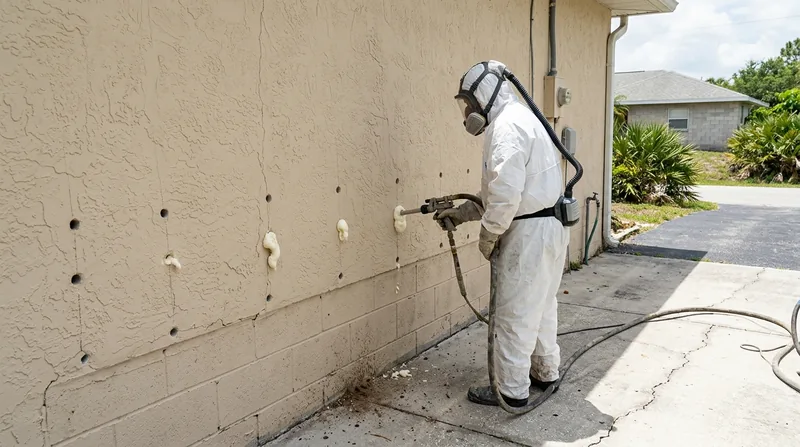




Wall & Injection Foam Insulation in Port St. Lucie addresses a structural reality that runs through nearly every home built here between the 1980s and early 2000s: concrete block walls, often stuccoed on the outside, with hollow cores that were never insulated. Port St. Lucie's climate zone 2A, hot, humid, with a cooling season that stretches eleven months a year, means that uninsulated block walls pull heat straight through to the air-conditioned interior. A single-story concrete block home on a slab foundation with uninsulated walls will run its air conditioning harder, cool unevenly, and lose conditioned air to the outdoor heat load before it reaches rooms far from the air handler. Injection foam fills those wall cavities from outside without disturbing interior drywall, trim, or finishes. The work is precise, non-invasive, and delivers R-value exactly where the thermal envelope fails. We have served Port St. Lucie and surrounding areas since 2011, and we know the homes, the lots, and the code that governs this work.
Why Wall & Injection Foam Insulation Matters in Port St. Lucie's Block Homes
Port St. Lucie's housing stock is dominated by single-story concrete block construction. These homes were built economically, with solid exterior walls and interior drywall, but the block cores were left hollow. In a climate where outdoor air temperatures exceed 85 degrees Fahrenheit for most of the year, and humidity never truly leaves, an uninsulated block wall acts as a thermal bridge. Heat radiates through the block directly into the conditioned space, and the air conditioning system must work continuously to offset that load. Rooms farthest from the air handler never reach setpoint, and the system cycles without rest.
- Uninsulated block walls conduct outdoor heat directly into living spaces, forcing air conditioning to run longer and harder.
- Injection foam fills the cavity from outside, eliminating the thermal bridge without interior demolition or drywall removal.
- The work is completed in a single day for a typical residential wall, with no interior disturbance.
- Sealed wall cavities also reduce moisture infiltration, which matters in Port St. Lucie's humid climate where vapor drive runs from outside to inside year-round.
Injection foam insulation stops that heat transfer at the source and pays for itself in reduced cooling costs over five to seven years in a climate this hot.
Key info: Port St. Lucie homes built in the 1980s and 1990s in neighborhoods like Tradition and St. Lucie West were designed to be affordable. Block walls without insulation were the cost-cutting choice. Today, those same homes are expensive to cool because of that choice. Injection foam retrofit is the only way to insulate those walls without tearing into the interior.
For more context on how spray foam insulation works across different building assemblies, see our guide to closed cell spray foam insulation in Port St. Lucie, which covers the technical fundamentals that apply to wall injection work as well.
For detailed information on local permitting and building code requirements specific to Port St. Lucie, consult the Port St. Lucie Building and Permitting Services, which administers the energy and building codes that govern insulation work in the city.
How Wall & Injection Foam Insulation Works: The Port St. Lucie Process
Injection foam insulation is a retrofit technique designed for existing walls. We drill small holes (typically 1.5 inches in diameter) through the exterior stucco at regular intervals, inject open cell or closed cell foam into the cavity, allow it to cure, and patch the holes. The entire process is conducted from outside. Interior drywall, baseboards, electrical outlets, and trim remain untouched. For a typical 1,500-square-foot home with uninsulated block walls on three sides, the work takes a single day.
- We assess the wall cavity depth and condition on site to determine foam type and injection pattern.
- Holes are drilled through stucco at measured intervals, typically 16 inches on center vertically and 24 inches horizontally.
- Foam is injected under controlled pressure until the cavity is completely filled and the foam expands to seal the space.
- After cure (typically 24 to 48 hours), holes are patched with stucco that matches the existing exterior finish.
- We verify fill density and coverage by sounding the wall and inspecting the injection pattern before patching.
The result is a fully insulated wall cavity with no interior disturbance, no loss of living space, and no visible change to the home's exterior appearance after patching.
Example: A 2,000-square-foot concrete block home in Palm City with three exterior walls and uninsulated block cores receives injection foam on all three walls. The work begins at 8 a.m., drilling and injection are complete by 4 p.m., and stucco patching is finished by end of business the next day. The homeowner is present during the work and can see the holes being filled and sealed. Interior finishes are never touched.
If your home also has uninsulated attic space above those walls, see our service page on attic spray foam insulation in Port St. Lucie to learn how sealing the attic and the walls work together to reduce cooling load.
Injection Foam Methods: Open Cell vs. Closed Cell for Wall Cavities
| Foam Type | Description | Best for Wall Cavities |
|---|---|---|
| Open Cell Foam | Lower density, softer, lower R-value per inch (3.5 to 4.0 R/in). Allows some moisture vapor transmission. Easier to inject into tight cavities and around obstructions. | Standard block wall cavities in Port St. Lucie homes where the cavity is clear and the goal is R-value without cost premium. |
| Closed Cell Foam | Higher density, rigid, higher R-value per inch (6.0 to 7.0 R/in). Vapor impermeable. More structural rigidity. Higher cost. | Walls in high-humidity areas or where moisture control is critical. Also specified when structural reinforcement of the wall is desired. |
| Hybrid or Partial Fill | Open cell foam to a certain depth, then closed cell on top. Balances cost and performance. | Retrofit jobs where budget is a factor but vapor control is desired in the upper portion of the wall. |
| Blown-In Loose-Fill (Fiberglass or Cellulose) | Not spray foam. Gravity-dependent, settles over time, lower density. Offers R-value but no air sealing or moisture control. | Not recommended for retrofit wall injection. Loose fill cannot be reliably injected into vertical cavities and will settle, leaving voids at the top. |
For most Port St. Lucie block wall injection projects, open cell foam is the standard choice. It fills the cavity completely, provides adequate R-value (typically R-13 to R-18 depending on cavity depth), and costs less than closed cell. Closed cell is specified when the homeowner prioritizes maximum R-value per inch or when the wall faces extreme moisture exposure (such as a wall directly facing the Atlantic in Jensen Beach or Stuart).
Wall & Injection Foam Insulation Cost in Port St. Lucie: What to Expect
Wall injection foam insulation in Port St. Lucie typically starts at $2.00 to $3.50 per square foot of wall surface, depending on cavity depth, foam type, and stucco condition. A 2,000-square-foot home with three exterior walls of uninsulated block (roughly 1,500 square feet of injectable wall surface) will cost between $3,000 and $5,250 for the complete injection, patching, and finishing. Closed cell foam runs 30 to 50 percent higher than open cell because of material cost and injection pressure requirements.
Several factors move the cost up or down from that baseline. Cavity depth matters: a 4-inch cavity requires less foam and less injection time than a 6-inch cavity. Stucco condition affects patching labor; if the stucco is old, weathered, or color-faded, matching the patch may require additional work or primer. Difficult access, such as a wall bordered by landscaping, a pool, or a fence, adds labor. Obstruction inside the cavity (electrical conduit, plumbing, or debris) may require selective drilling or cavity clearing.
We recommend getting two to three estimates from local contractors. Each estimate should specify the foam type (open or closed cell), the expected R-value and thickness, the number of injection points, and the patching method. A written estimate with these details is the only way to compare apples to apples. Estimates that omit R-value, thickness, or foam type are not comparable and should raise a red flag.
For a detailed breakdown of pricing across all our services, including volume discounts and multi-wall projects, see our full pricing page.
Wall & Injection Foam Insulation Near Me: What Port St. Lucie Homeowners Should Know When Hiring
Hiring a spray foam contractor for wall injection work requires the same due diligence as any home improvement project. The spray foam trade includes both local, long-standing shops and out-of-state rig-and-run crews that spray a job in an afternoon and disappear. The difference is not always visible in the estimate, so you must ask the right questions and verify the answers.
Start by confirming that the contractor is fully insured and can provide a current certificate of insurance on request. Ask for references from Port St. Lucie homeowners who had wall injection work done in the last two years, and call them to ask whether the patching matched, whether the smell cleared within 48 hours, and whether they would hire the contractor again. Verify that the contractor has a local address and local business registration in the city where you live. Check the Port St. Lucie Better Business Bureau for any complaints or disputes.
Get a written estimate that includes the foam type, R-value, cavity depth, number of injection points, and the patching method. If the estimate omits these details, ask for them in writing before you sign anything. Do not accept an estimate that promises immediate re-entry or no smell; correct spray foam installation requires 24 to 48 hours before the space is fully cured and re-entry is safe. Any contractor who promises otherwise does not understand the product.
Ask about permits. In Port St. Lucie, wall injection work may or may not require a permit depending on the scope and your location. The contractor should know what applies at your address and should help you navigate what the building department requires. If the contractor says "no permits needed" without asking where you live or what your HOA rules are, that is a warning sign.
For a free estimate and a conversation with someone who knows Port St. Lucie homes and the work involved, contact us today or call (772) 877-0850. We respond within 24 hours and can schedule a site visit at your convenience.
Wall & Injection Foam Insulation in Port St. Lucie: Pricing Guide
| Service | Price | Details |
|---|---|---|
| Open Cell Wall Injection | Starting at $2.00/sq ft | Standard retrofit for concrete block walls. Cavity depth and stucco condition affect final cost per square foot. |
| Closed Cell Wall Injection | Starting at $3.00/sq ft | Higher R-value and vapor control. Recommended for walls with moisture exposure or maximum insulation value required. |
| Stucco Patch & Finish | Included | Color match and texture repair after injection holes are sealed. Extra labor if stucco is faded or requires primer. |
| Multi-Wall Project (3+ walls) | Volume discount available | Larger jobs qualify for reduced per-square-foot pricing. Site visit required to confirm cavity condition and scope. |
| Estimate | Free | Written estimate with R-value and thickness specs. Response within 24 hours. No obligation to book. |
Indicative pricing, the exact cost depends on square footage, finish, and site access. Free personalized estimate within 24h at (772) 877-0850.


